Rhodiola rosea has been the subject of human clinical research for several decades, much of it originating in Scandinavian and Eastern European research institutions where the plant has a long history of traditional use.
Before looking at supplement marketing claims, it helps to understand what the actual published research does and does not show.
This post contains affiliate links. As an Amazon Associate we earn from qualifying purchases, at no extra cost to you.
Stress and Fatigue Studies
Several small, placebo-controlled trials have looked at rhodiola extract in people experiencing stress-related fatigue, generally measuring outcomes like self-reported energy, concentration, and mood using standardized questionnaires.
These studies tend to run a few weeks and use daily doses in the range commonly sold in supplement form, rather than mega-doses.
The most frequently cited work here is a 2000 crossover trial in 56 healthy physicians on night duty. Participants took a standardised extract (SHR-5) on a repeated low-dose regimen across three two-week periods, with a washout in between, and were measured on a Fatigue Index built from five tests covering short-term memory, calculation, concentration and speed of audio-visual perception. The treatment period produced a statistically significant improvement over placebo.[1]
A 2009 Phase III trial took a different population: 60 adults aged 20 to 55 who met Swedish national diagnostic criteria for fatigue syndrome, randomised to either 576 mg of SHR-5 extract per day or placebo for 28 days. The outcomes were not just self-reported energy. The trial tracked quality of life on the SF-36, burnout on the Pines scale, depression on MADRS, sustained attention on a computerised continuous performance test, and the salivary cortisol response to awakening.[2]
Physical Performance Research
A separate body of research has examined rhodiola in the context of endurance exercise, typically measuring time to exhaustion or perceived exertion during controlled workouts.
Results across these smaller studies are mixed, with some showing modest improvements in perceived exertion and others finding no measurable difference from placebo.
The endurance literature usually starts with a 2004 double-blind study run in two phases (n=24, then n=12). It used 200 mg of extract standardised to 3% rosavin and 1% salidroside, taken one hour before testing, compared against a starch placebo in a crossover design with a five-day washout. It separated acute intake from four weeks of daily intake, and it tested several different things at once: limb movement speed, aural and visual reaction time, sustained attention, maximal isometric knee-extension torque, and endurance exercise capacity.[3]
That separation matters, because the results did not move together across those measures. A 2022 systematic review covering rhodiola as an exercise supplement reached the same broad conclusion: only a handful of studies have tested it in a sport context, and most of those reported benefits for performance, though not for every outcome, such as perceived exertion.[4]

Mood-Related Research
A number of trials have also studied rhodiola alongside mild to moderate low mood, usually comparing it to a placebo or, in a few cases, to a standard first-line treatment over a short trial period.
These studies are generally small in size, which is an important limitation to keep in mind when interpreting the results.
A 2015 trial randomised 80 mildly anxious participants to either 2 × 200 mg of a commercial extract (one tablet before breakfast, one before lunch) or a no-treatment control, with self-report measures and cognitive tests at four sessions over 14 days. Self-reported anxiety, stress, anger, confusion and depression all fell relative to controls, and total mood improved. Cognitive performance did not differ between the groups. The authors were explicit that this was not a placebo-controlled trial and that a causal relationship cannot be claimed from it.[5]
A separate 2015 randomised placebo-controlled trial compared rhodiola directly against sertraline in major depressive disorder. A head-to-head against an established prescription antidepressant is unusual for a botanical, and it is worth reading in full rather than in summary, because the informative part is the size and precision of the differences rather than which arm nominally came out ahead.[6]
Limitations Worth Knowing
Most rhodiola trials involve relatively small groups of participants, often several dozen rather than several hundred, and trial lengths are usually measured in weeks rather than months or years.
This means the existing evidence is useful as an early signal but is not the same level of proof as the large, long-term trials required for pharmaceutical approval.
The most useful single check on all of this is a 2012 systematic review. It screened 206 articles and found 11 that met inclusion criteria, ten described as randomised controlled trials and one as a controlled clinical trial. Of six trials examining physical fatigue in healthy people, two reported rhodiola effective. Of five evaluating mental fatigue, three did. The central finding is not that count, though: every included study carried either a high risk of bias or reporting flaws serious enough to limit confidence in the result.[7]
That conclusion is why a 2014 randomised controlled trial in nursing students was framed by its own authors around the point that a well-designed, rigorously conducted trial is needed before therapeutic claims for this product can reasonably be made.[8]
How to Read a Rhodiola Trial
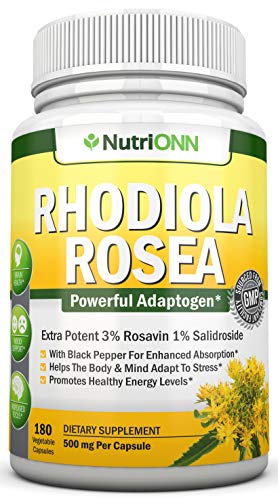
Because extracts differ, the single most useful question to ask of any rhodiola result is which preparation it used. Most of the stress and fatigue evidence rests on one standardised extract, SHR-5, at a specific dose and duration.[1][2] The endurance work used a different preparation standardised to 3% rosavin and 1% salidroside.[3] A product matching neither has not been tested by any of these trials, whatever the label implies.
Four other details decide how much a given study should move your thinking: the daily dose in milligrams of extract rather than raw root, how long the trial ran, whether the population was healthy or clinically fatigued, and whether the outcome was a validated instrument or a single self-rating. The 2009 trial is informative largely because it reported a spread of instruments plus a physiological marker rather than one questionnaire.[2]
Sample size is the last filter. These are trials of dozens of people, not thousands, run over weeks rather than years. That is enough to detect a reasonably large short-term effect, and not enough to characterise a small one, rule out uncommon harms, or say anything about long-term use.[7]
Frequently Asked Questions
Is rhodiola FDA-approved for any condition?
No. Rhodiola is sold as a dietary supplement in the United States, not an FDA-approved drug, and is not evaluated by the FDA for treating any specific condition.
How many human studies exist on rhodiola?
There is a meaningful body of published research, but the overall number of large, high-quality trials remains limited compared to well-studied pharmaceuticals, which is typical for most botanical supplements.
Do all studies agree on rhodiola’s effects?
No. Results vary across trials, particularly for physical performance outcomes, which is one reason researchers consistently call for larger, longer studies.
Should clinical research change how I use rhodiola?
It is worth reading beyond marketing claims and understanding that current evidence, while promising in some areas, is still considered preliminary by most researchers in the field.
Where can I read the actual studies?
Every study named on this page is listed in the References section below with its PubMed ID, so you can read the original abstracts directly. If you want one starting point, the 2012 systematic review is the most useful, because it assesses the quality of the underlying trials rather than only reporting their conclusions.[7]


References
- Darbinyan V, Kteyan A, Panossian A, et al. Rhodiola rosea in stress induced fatigue: a double blind cross-over study of a standardized extract SHR-5 with a repeated low-dose regimen on the mental performance of healthy physicians during night duty. Phytomedicine (2000). PMID 11081987
- Olsson EM, von Schéele B, Panossian AG. A randomised, double-blind, placebo-controlled, parallel-group study of the standardised extract SHR-5 of the roots of Rhodiola rosea in the treatment of subjects with stress-related fatigue. Planta Medica (2009). PMID 19016404
- De Bock K, Eijnde BO, Ramaekers M, Hespel P. Acute Rhodiola rosea intake can improve endurance exercise performance. International Journal of Sport Nutrition and Exercise Metabolism (2004). PMID 15256690
- Lu Y, Deng B, Xu L, et al. Effects of Rhodiola rosea supplementation on exercise and sport: a systematic review. Frontiers in Nutrition (2022). PMID 35464040
- Cropley M, Banks AP, Boyle J. The effects of Rhodiola rosea L. extract on anxiety, stress, cognition and other mood symptoms. Phytotherapy Research (2015). PMID 26502953
- Mao JJ, Xie SX, Zee J, et al. Rhodiola rosea versus sertraline for major depressive disorder: a randomized placebo-controlled trial. Phytomedicine (2015). PMID 25837277
- Ishaque S, Shamseer L, Bukutu C, Vohra S. Rhodiola rosea for physical and mental fatigue: a systematic review. BMC Complementary and Alternative Medicine (2012). PMID 22643043
- Punja S, Shamseer L, Olson K, Vohra S. Rhodiola rosea for mental and physical fatigue in nursing students: a randomized controlled trial. PLoS ONE (2014). PMID 25268730
These statements have not been evaluated by the FDA. This product is not intended to diagnose, treat, cure, or prevent any disease.
These statements have not been evaluated by the Food and Drug Administration. This information is not intended to diagnose, treat, cure, or prevent any disease. Content is for informational purposes only and is not medical advice; consult a qualified healthcare provider before starting any supplement. As an Amazon Associate we earn from qualifying purchases.
