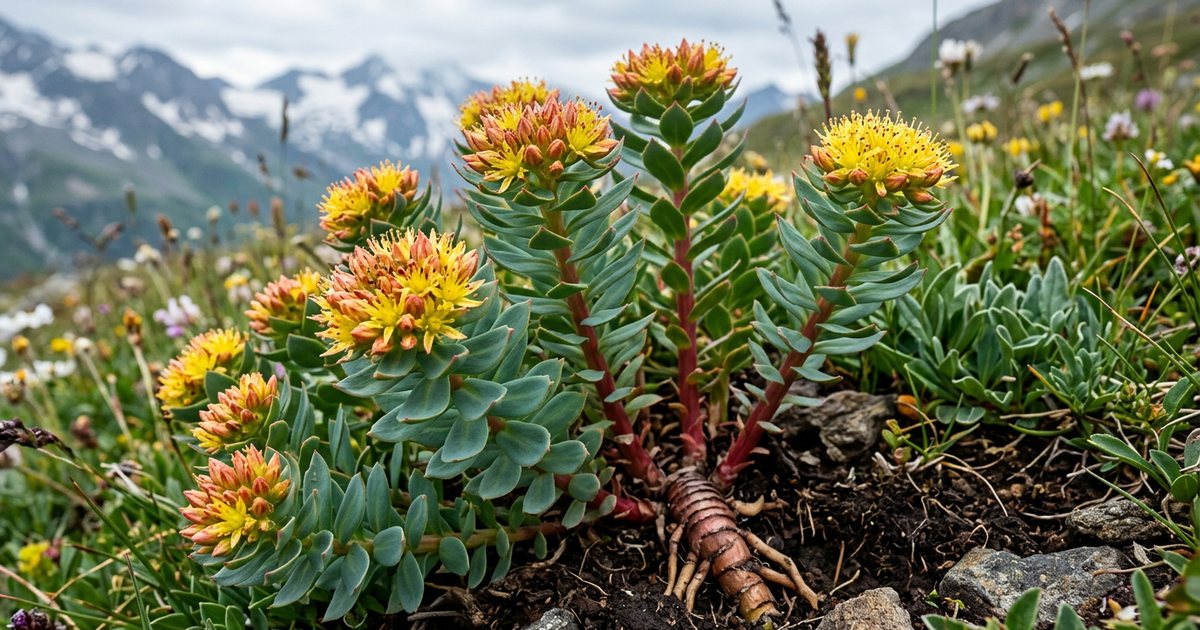
Rhodiola rosea is a flowering plant that grows in cold, high-altitude regions of Europe, Asia, and North America. It has been used for centuries in Russian and Scandinavian folk medicine to help the body cope with cold, altitude, and physical strain.
Modern researchers classify rhodiola as an adaptogen, a category of plant compounds believed to help the body maintain balance under different types of stress. Understanding how it works starts with its two main groups of active compounds.
This post contains affiliate links. As an Amazon Associate we earn from qualifying purchases, at no extra cost to you.
Rosavins and Salidroside
Rhodiola’s effects are generally attributed to two families of compounds: rosavins (found almost exclusively in Rhodiola rosea) and salidroside, a compound shared with a few related plants.
Phytochemical work has isolated roughly 140 separate compounds from the root and rhizome of the plant[1], including the phenylpropanoid glycosides rosin, rosarin and rosavin alongside salidroside and tyrosol[2]. That is why extracts are described by a compound profile rather than by a single active ingredient.
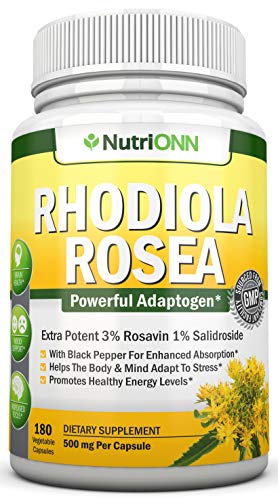
Most standardized extracts on the market are calibrated to a ratio of these two compounds, commonly around 3% rosavins to 1% salidroside, because that ratio mirrors the wild root chemistry used in early research.
Interaction with Stress Hormones
Rhodiola is thought to influence the hypothalamic-pituitary-adrenal axis, the signaling system that governs the release of cortisol and other stress hormones.
This pathway is testable rather than purely theoretical. A 28-day randomised, double-blind, placebo-controlled trial in 60 adults meeting diagnostic criteria for fatigue syndrome measured the salivary cortisol response to awakening directly, alongside fatigue, depression and attention outcomes[3].
By moderating this signaling, some researchers propose that rhodiola helps blunt the sharp hormonal spikes associated with acute stress, rather than eliminating the stress response altogether.

Neurotransmitter Activity
Salidroside and related compounds appear to interact with serotonin and dopamine pathways in the brain, which is one reason rhodiola is often studied alongside mood and fatigue rather than purely physical endurance.
Laboratory work supports a plausible route. Methanol and water extracts of rhodiola root inhibited monoamine oxidase A and B in a microtitre-plate bioassay, with the constituent rosiridin the most active single compound isolated[4]. Monoamine oxidase is the enzyme that breaks serotonin and dopamine down, so inhibiting it is one route by which a plant extract can reach those pathways.
This dual action on both the endocrine system and brain chemistry is what separates adaptogens like rhodiola from simple stimulants such as caffeine.
Antioxidant Support
Rhodiola also contains phenolic compounds with antioxidant properties, which may help offset some of the oxidative stress that builds up during intense physical or mental exertion.
Dry extracts of rhodiola have been assayed for antioxidant capacity using the DPPH, ABTS and FRAP methods, and the measured activity tracked the concentration of phenolics such as salidroside, tyrosol and rosavin derivatives[5].
This is considered a secondary mechanism, supporting recovery rather than driving the adaptogenic effects most people take rhodiola for.

Frequently Asked Questions
Is rhodiola a stimulant like caffeine?
No. Rhodiola does not directly stimulate the central nervous system the way caffeine does. Its effects on energy and fatigue are linked to hormonal and neurotransmitter regulation rather than direct stimulation.

How is rhodiola different from other adaptogens like ashwagandha?
Both are classified as adaptogens, but they contain different active compounds. Rhodiola’s rosavin and salidroside profile is unique to it, while ashwagandha relies on withanolides. Some people use them for different purposes or stack them together.
Does rhodiola work the same for everyone?
Individual response varies based on factors like baseline stress levels, dose, and extract standardization. This is why starting with a lower dose and tracking your own response matters more than following a one-size-fits-all protocol.
What extract ratio should I look for?
Look for products that clearly state their rosavin and salidroside percentages on the label, commonly standardized to a 3:1 ratio, so you know what you are actually taking.
Does rhodiola affect cortisol directly?
Research suggests rhodiola may modulate the signaling that governs cortisol release rather than blocking cortisol production outright, though the exact mechanism is still being studied.
These statements have not been evaluated by the FDA. This product is not intended to diagnose, treat, cure, or prevent any disease.
References
- Rosenroot (Rhodiola rosea): traditional use, chemical composition, pharmacology and clinical efficacy. Phytomedicine, 2010
- Phenylpropanoid glycosides from Rhodiola rosea. Chem Pharm Bull (Tokyo), 2003
- A randomised, double-blind, placebo-controlled, parallel-group study of the standardised extract SHR-5 of the roots of Rhodiola rosea in the treatment of subjects with stress-related fatigue. Planta Med, 2009
- Monoamine oxidase inhibition by Rhodiola rosea L. roots. J Ethnopharmacol, 2009
- Antioxidant and Antibacterial Activity of Roseroot (Rhodiola rosea L.) Dry Extracts. Molecules, 2018
These statements have not been evaluated by the Food and Drug Administration. This information is not intended to diagnose, treat, cure, or prevent any disease. Content is for informational purposes only and is not medical advice; consult a qualified healthcare provider before starting any supplement. As an Amazon Associate we earn from qualifying purchases.
