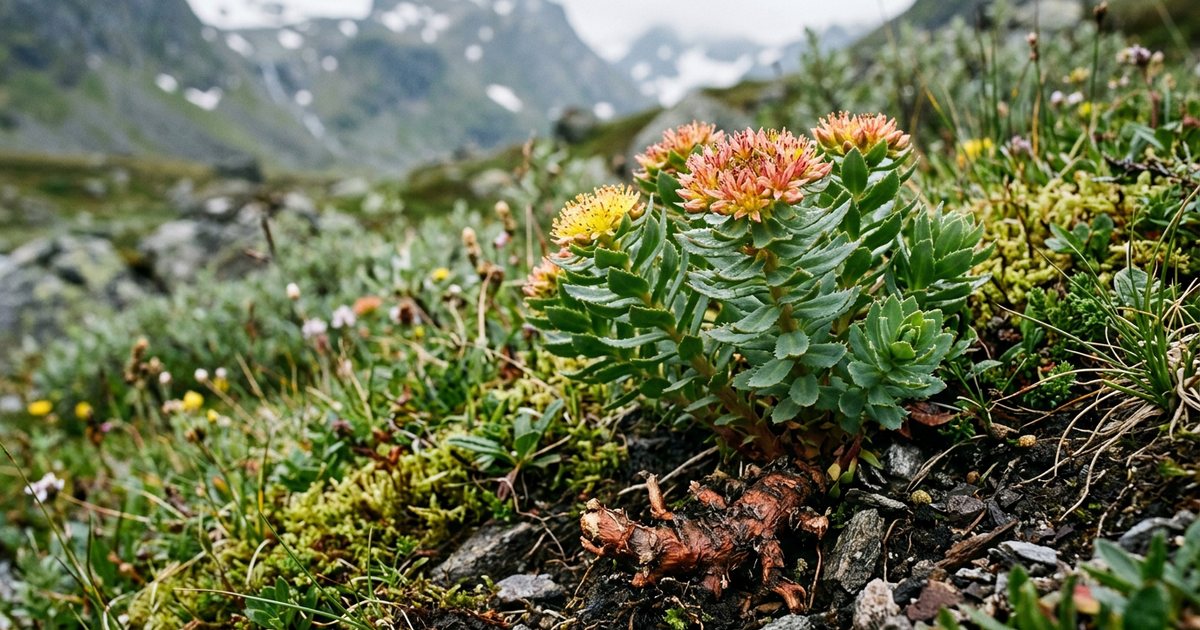
Rhodiola rosea, often referred to as ‘golden root’ or ‘roseroot,’ has a rich and extensive history of use in various traditional health practices. This adaptogenic herb has been valued across different cultures for centuries, particularly in challenging environments where resilience was key.
Understanding the traditional uses of rhodiola can offer valuable context for its contemporary applications, especially for women navigating the unique physiological and emotional shifts of midlife and menopause. This article explores the historical journey of rhodiola, from its ancient origins to its place in modern wellness discussions.
Ancient Roots and Siberian Traditions
The history of rhodiola rosea is deeply intertwined with the traditional practices of various northern and high-altitude regions. Its use has been documented for over a thousand years, with its origins often traced back to the harsh climates of Siberia and parts of Asia [1]. The plant thrives in cold, mountainous areas, making it a natural resource for communities living in such environments.
In traditional Siberian folk practices, rhodiola was highly valued. It was often consumed to help the body adapt to physical stressors and to support general vitality [1]. The plant’s ability to grow in extreme conditions likely contributed to the belief in its strengthening properties for those facing similar environmental challenges.
The traditional knowledge surrounding rhodiola was often passed down through generations, with specific methods of harvesting and preparation developed over time. This long history of use in diverse cultural settings underscores its significance as a traditional botanical.
Traditional Uses Across Different Cultures
Beyond Siberia, rhodiola rosea and related Rhodiola species have a long history of traditional use in other parts of the world. For example, some Rhodiola species have been used in Chinese traditional practices for their potential effects on energy metabolism and other bodily functions [2][3]. Similarly, indigenous communities in regions like Kohistan, North Pakistan, have incorporated various plants, including those with adaptogenic properties, into their traditional medical ethnobotany [4].

The historical use of rhodiola has also been noted in Scandinavia, where Vikings reportedly utilized the herb to support physical endurance during long journeys and strenuous activities [1]. These diverse traditional applications highlight a common thread: the belief that rhodiola could help individuals cope with various forms of physiological and environmental stress.
These long-standing traditional uses across different cultures suggest a shared recognition of rhodiola’s potential to support well-being, particularly in contexts where resilience and adaptability were highly valued [5].
From Folk Remedy to Modern Interest
For centuries, rhodiola rosea remained primarily a folk remedy, with its knowledge largely confined to the communities that harvested it from the wild [6]. However, in the 20th century, scientific interest in adaptogenic plants, including rhodiola, began to grow. Researchers started to investigate the compounds within these plants and their potential interactions with human physiology [5].
This shift marked a transition from purely anecdotal evidence to more systematic study. The traditional uses of rhodiola provided a valuable starting point for modern research, guiding scientists to explore its potential in areas such as stress response and physical capacity [7]. The concept of ‘adaptogens’ – substances that may help the body adapt to various stressors – gained traction, and rhodiola rosea became a prominent example [5].

Today, rhodiola is a subject of ongoing research into its potential effects on various aspects of human health, moving from its ancient origins as a revered plant to a botanical of interest in contemporary wellness discussions [7][8][9].
Rhodiola’s Place in Modern Wellness for Midlife Women
For women navigating midlife and menopause, the traditional uses of rhodiola offer an interesting historical perspective. The shifts experienced during these life stages can involve various physiological and emotional adjustments. Historically, rhodiola was valued for its potential to support the body’s ability to adapt to challenges, which aligns with some of the contemporary interests in managing midlife transitions.
While traditional uses provide a rich backdrop, it’s important to recognize that modern scientific understanding continues to evolve. Current research explores rhodiola’s potential in areas such as supporting the body’s response to stress and promoting a sense of well-being, which may be relevant for women experiencing the changes associated with midlife and menopause [7][10].
The journey of rhodiola from ancient Siberian practices to its current presence in global wellness discussions highlights its enduring appeal. Its long history of traditional use underscores a sustained human interest in botanicals that may support resilience and adaptability, a theme that resonates with many women seeking ways to navigate midlife and menopause with greater ease.


References
- Rosenroot (Rhodiola rosea): traditional use, chemical composition, pharmacology and clinical efficacy. Phytomedicine : international journal of phytotherapy and phytopharmacology, 2010
- Rhodiola crenulata alleviates hypobaric hypoxia-induced brain injury by maintaining BBB integrity and balancing energy metabolism dysfunction. Phytomedicine : international journal of phytotherapy and phytopharmacology, 2024
- [Effect of fertilization combinations of nitrogen, phosphorus, and potassium on four phenolic compounds of cultivated Rhodiola crenulata]. Zhongguo Zhong yao za zhi = Zhongguo zhongyao zazhi = China journal of Chinese materia medica, 2018
- Standard medical ethnobotany of Kohistan, North Pakistan. Journal of ethnobiology and ethnomedicine, 2024
- Plant Adaptogens-History and Future Perspectives. Nutrients, 2021
- Running out of time to smell the roseroots: Reviewing threats and trade in wild Rhodiola rosea L. Journal of ethnopharmacology, 2021
- The Effectiveness of Rhodiola rosea L. Preparations in Alleviating Various Aspects of Life-Stress Symptoms and Stress-Induced Conditions-Encouraging Clinical Evidence. Molecules (Basel, Switzerland), 2022
- Anti-inflammatory effects of Rhodiola rosea L.: A review. Biomedicine & pharmacotherapy = Biomedecine & pharmacotherapie, 2020
- Salidroside intensifies mitochondrial function of CoCl(2)-damaged HT22 cells by stimulating PI3K-AKT-MAPK signaling pathway. Phytomedicine : international journal of phytotherapy and phytopharmacology, 2023
- Clinician guidelines for the treatment of psychiatric disorders with nutraceuticals and phytoceuticals: The World Federation of Societies of Biological Psychiatry (WFSBP) and Canadian Network for Mood and Anxiety Treatments (CANMAT) Taskforce. The world journal of biological psychiatry : the official journal of the World Federation of Societies of Biological Psychiatry, 2022
These statements have not been evaluated by the Food and Drug Administration. This information is not intended to diagnose, treat, cure, or prevent any disease. Content is for informational purposes only and is not medical advice; consult a qualified healthcare provider before starting any supplement. As an Amazon Associate we earn from qualifying purchases.
