Long before rhodiola rosea appeared on supplement shelves, it grew wild across the Arctic and mountainous regions of Siberia, Scandinavia, and parts of North America, where harsh, cold climates shaped its use in folk medicine.
Its history stretches from regional herbal tradition to Cold War-era research programs and, eventually, to the global wellness market it occupies today.
This post contains affiliate links. As an Amazon Associate we earn from qualifying purchases, at no extra cost to you.
Traditional Use in Cold Climates
Communities in Siberia, Scandinavia, and the Caucasus region traditionally used rhodiola root to help cope with the physical demands of cold weather, high altitude, and heavy labor.
It was often brewed as a tea or tincture and passed down through regional herbal knowledge long before formal scientific study began.
Rhodiola rosea is a perennial in the Crassulaceae family that grows at high altitude and high latitude, and it was an established medicinal plant in Russia and Scandinavia long before it appeared on any supplement shelf. Traditional use centred on stimulating the nervous system, reducing fatigue, improving work performance and preventing symptoms at altitude.[1]
A 2010 review that catalogues the traditional and official medical use of the plant alongside its chemistry and pharmacology is the most complete account of that history in the English-language literature, and it is the source most later summaries are drawing on, usually without saying so.[2]
Soviet-Era Research
Rhodiola drew serious scientific attention in the mid-20th century when Soviet researchers studied adaptogenic plants, partly with interest in supporting endurance for military and athletic applications.
Much of this early research was published in Russian scientific journals and only became more widely known outside the region decades later.
The word adaptogen itself comes out of this period. It was applied to a small group of plant extracts studied for the capacity to raise the body’s stability against physical loads without a large increase in oxygen consumption. Rhodiola rosea sits in that group alongside Panax ginseng, Eleutherococcus senticosus, Rhaponticum carthamoides and Schisandra chinensis.[3]
Much of the early work circulated in Russian-language journals and internal reports rather than in indexed international literature, which is the practical reason so much of it is cited secondhand today. Treat any specific claim traceable only to that era as harder to verify than a modern trial, not as stronger for being older.[3]
Introduction to Western Markets
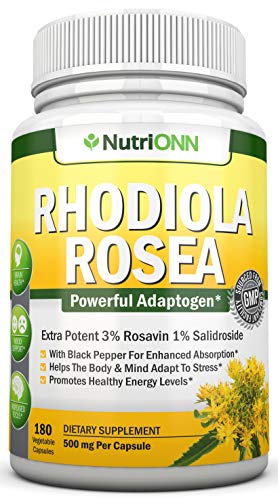
Rhodiola extracts began appearing in Scandinavian and Western European supplement markets in the 1980s and 1990s, often marketed for stress resilience and mental fatigue.
It reached mainstream popularity in the United States later, as adaptogens broadly gained interest from consumers looking for alternatives to stimulant-based energy products.
Western availability followed the standardisation of specific extracts for clinical study rather than the other way round. The extract that recurs throughout the modern trial literature was developed and studied through Swedish research groups, which is why so much of the fatigue and burnout evidence traces back to a single preparation and a small set of investigators.[2]
Rhodiola Today
Today, rhodiola is one of the more widely studied adaptogens, cultivated commercially rather than solely wild-harvested, with standardized extract manufacturing to ensure consistent rosavin and salidroside content.
Its long traditional history alongside a growing body of modern research is part of why it remains a staple in the adaptogen category.
The plant is now a routine subject of stress and fatigue research rather than a curiosity. A 2018 review written for a clinical psychiatry audience assessed where it fits among prevention and treatment options for stress-related symptoms and burnout, which is a very different framing from the traditional-use accounts and a fair marker of how far the research conversation has moved.[4]
What the Chemistry Turned Out to Be
The historical claims came first and the chemistry came later. Roughly 140 compounds have been isolated from the root and rhizome, including monoterpene alcohols and their glycosides, cyanogenic glycosides, aryl glycosides, phenylethanoids, phenylpropanoids and their glycosides, flavonoids, flavonolignans, proanthocyanidins and gallic acid derivatives.[2]
Of those, three names do most of the work in modern product labelling: salidroside (also written rhodioloside), the rosavins, and p-tyrosol.[1] The rosavins in particular are used to distinguish Rhodiola rosea from other Rhodiola species sold under the same common name, which is a practical consequence of the botany rather than a marketing invention.[5]
This is the part of the history that matters when buying. A traditional-use claim describes the whole root as it was used for centuries; a standardised extract describes a defined percentage of specific marker compounds. Those are not interchangeable statements, and the older the citation behind a claim, the less likely it refers to anything resembling a modern capsule.[2]
Frequently Asked Questions
Where does rhodiola rosea originally grow?
It is native to cold, high-altitude regions including Siberia, Scandinavia, the Caucasus Mountains, and parts of Arctic North America.


Is rhodiola a new supplement trend?
No. Its traditional use dates back centuries in regional folk medicine, even though it only became widely available as a commercial supplement in recent decades.
Who first studied rhodiola scientifically?
Formal scientific interest grew significantly during Soviet-era research into adaptogenic plants in the mid-20th century.
Is wild-harvested rhodiola better than cultivated?
Not necessarily. Reputable cultivated sources allow for standardized rosavin and salidroside content, which is harder to guarantee with wild-harvested root.
Why is rhodiola called an adaptogen?
The term describes plants believed to help the body adapt to physical or mental stress, a category that grew out of the same research tradition that first studied rhodiola.

References
- Khanum F, Bawa AS, Singh B. Rhodiola rosea: a versatile adaptogen. Comprehensive Reviews in Food Science and Food Safety (2005). PMID 33430554
- Panossian A, Wikman G, Sarris J. Rosenroot (Rhodiola rosea): traditional use, chemical composition, pharmacology and clinical efficacy. Phytomedicine (2010). PMID 20378318
- Todorova V, Ivanov K, Delattre C, et al. Plant adaptogens: history and future perspectives. Nutrients (2021). PMID 34445021
- Anghelescu IG, Edwards D, Seifritz E, Kasper S. Stress management and the role of Rhodiola rosea: a review. International Journal of Psychiatry in Clinical Practice (2018). PMID 29325481
- Rhodiola plants: chemistry and biological activity. Journal of Food and Drug Analysis (2015). PMID 28911692
These statements have not been evaluated by the FDA. This product is not intended to diagnose, treat, cure, or prevent any disease.
These statements have not been evaluated by the Food and Drug Administration. This information is not intended to diagnose, treat, cure, or prevent any disease. Content is for informational purposes only and is not medical advice; consult a qualified healthcare provider before starting any supplement. As an Amazon Associate we earn from qualifying purchases.
