Ready to buy? Check current prices on Amazon and compare deals before you decide.
As women navigate midlife and the changes of menopause, understanding the nuances of supplements like rhodiola rosea can be helpful. While rhodiola rosea is a single species, its natural growing conditions can vary significantly across different regions.
The claim that wild Siberian and Scandinavian rhodiola is more potent than rhodiola grown anywhere else is common on labels and rare in the literature. It has, however, been measured, both in the plant and in finished supplements. This article walks through what those measurements found, which is not what the marketing implies, and what is actually worth checking before you buy.
The Influence of Terroir on Plant Compounds
Just as the ‘terroir’ of a wine region—its soil, climate, and topography—influences the characteristics of grapes, similar environmental factors can impact the biochemical composition of medicinal plants. Rhodiola rosea is a hardy plant known to thrive in harsh, cold, high-altitude conditions.

The specific stresses of its natural habitat, such as extreme temperatures, intense UV radiation, and nutrient-poor soils, may prompt the plant to produce a unique profile of protective compounds. These compounds are often what contribute to the plant’s adaptogenic properties.
Siberian and Scandinavian Origins: A Look at Harsh Environments
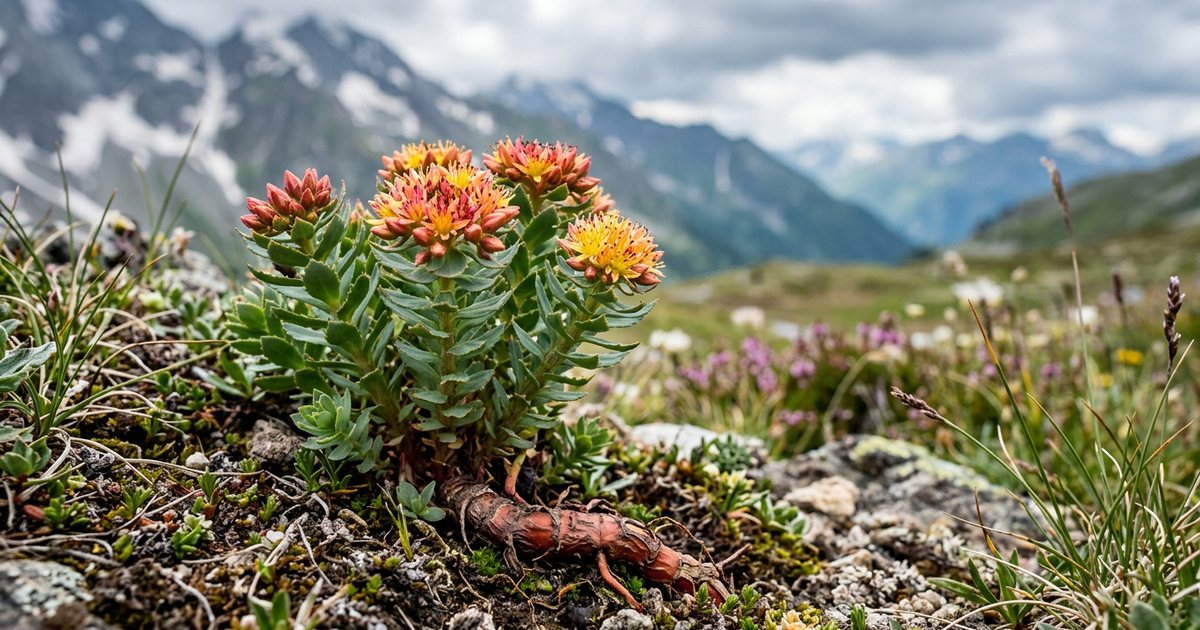
Wild rhodiola rosea from Siberia and Scandinavia naturally grows in some of the world’s most challenging climates. These regions are characterized by long, severe winters, short growing seasons, and high altitudes. Such conditions are believed to encourage the plant to develop a robust defense mechanism.
The plant’s response to these environmental stressors involves synthesizing a range of secondary metabolites, including the active compounds often associated with rhodiola’s effects. The obvious next step is to ask whether that actually shows up as more active compound in the root, and researchers have run that comparison in the Altai Mountains of southern Siberia.
One study compared wild R. rosea collected from natural populations in the Altai Mountains against plants of the same species cultivated at the Siberian Botanical Garden in Tomsk[1]. Salidroside in the wild rhizomes ranged from 0.02% to 0.48% of dry weight, a twenty-four-fold spread between samples taken from the same mountain system. Rosavin ranged from 0.77% to 1.57%. The cultivated plants did not come out weaker: they carried a higher salidroside content than the wild populations, at a comparable rosavin content.
Two things follow from that, and both cut against the usual sales pitch. Wild Siberian origin is a weak predictor of a stronger root, because the variation between individual wild stands is wider than the difference the label language implies. And cultivation does not automatically cost you the active compounds, which matters for a slow-growing alpine plant whose medicinal part is the rhizome, so that wild harvesting takes the whole plant. This is one study and one region, so it settles the direction of the evidence rather than the whole question, but it is the comparison the potency claim depends on, and it does not support it.
Key Active Compounds: Rosavins and Salidroside
The primary active compounds often standardized in rhodiola rosea extracts are rosavins (rosavin, rosin, rosarin) and salidroside. These compounds are believed to be responsible for many of rhodiola’s adaptogenic properties.

The ratios and concentrations do vary widely from product to product. What the analytical work does not do is single out wild Siberian material as the source of optimal levels. When seven commercial R. rosea extracts were assayed for both marker content and biological activity, the marker content varied to a high degree across products, including among extracts all drawn from the Altai geographic region, and one extract from China contained no rosavin at all[2]. Provenance on its own did not predict what was in the extract.
That same study carries a caveat worth keeping. The extracts with the highest marker content were the ones active at the lowest concentrations tested, so the markers do track something real. But some extracts also contained other compounds that appeared to reduce activity, which led the authors to conclude that a standardized marker content is necessary for quality control and still not sufficient to predict how a preparation will behave.
Wild vs. Cultivated Rhodiola: Potential Differences
The distinction between wild-harvested and cultivated rhodiola rosea is another factor to consider. Wild plants grow in their natural ecosystem, where they are exposed to the full spectrum of environmental challenges that shaped their evolution. This natural stress could lead to different biochemical profiles.
Cultivated rhodiola, while ensuring sustainability and consistency, may not experience the same intensity of environmental stressors as its wild counterparts. This difference in growing conditions could potentially influence the plant’s overall chemical composition and, by extension, its characteristics.

What the Label Is and Is Not Telling You
If growing region is a weak signal, what is a strong one? The supply chain, and unlike terroir it has been measured directly on the shelf.
Around 40 commercial Rhodiola products sold in the UK and Europe were analysed by chromatography, mass spectrometry and NMR. About one fifth of the products claiming to be R. rosea contained no rosavin, the marker compound used to tell R. rosea apart from related species, and some appeared to contain no salidroside either. Of the products that did contain rosavin, roughly 80% held less of it than the registered herbal medicines used as the comparison, and appeared to be adulterated with other Rhodiola species. Rhodiola crenulata, a different species used in traditional Chinese medicine, is the adulterant the authors flag as common in the R. rosea trade[3].
A 2026 analysis of the United States market arrived in a similar place from a different direction. Across what its authors describe as a small but representative sample of US retail products, rosavin content ran from 0.01% to 3.08% and salidroside from 0.07% to 2.91%, with what the authors call substantial aberrations from the advertised amounts. One product showed an undisclosed and likely synthetic addition of salidroside. All seven capsule products tested carried trace arsenic, cobalt and lead; two held notably elevated cobalt and arsenic, which the authors are careful to say would need follow-up arsenic speciation before anyone can judge it against federal minimal-risk levels. Pesticide residues were below detection limits[4].
Put the two together and the scale of the problem sorts itself out. A rosavin range of 0.01% to 3.08% across products on a single market is a more than three-hundred-fold spread. No growing region contributes a difference of that size. Which bottle you pick matters enormously; which mountain it came from is lost in the noise.
What to Check Instead of Origin
None of this makes rhodiola a poor choice, and none of it means growing conditions are irrelevant to plant chemistry. It means origin is the wrong thing to shop on, because you cannot verify it and it does not predict potency. Three things you can verify:
- The species. The label should say Rhodiola rosea. If it says Rhodiola crenulata, or only “Rhodiola” with no species at all, you are not necessarily buying the plant the Western clinical literature was built on.
- A stated standardization, as a number. Rosavins and salidroside are the two biomarkers every one of the analyses above measured, so a label that commits to a percentage of each gives you something to hold the brand to. “Potent extract” and “full spectrum” give you nothing to check.
- A third-party certificate of analysis for the lot you are buying. This is the only one of the three that closes the gap between what the label claims and what the capsule contains, and that gap is precisely what both market analyses measured.
“Wild-harvested” and “Siberian” describe where a root came from. Neither is a measurement, and in the one study that compared the two populations head to head, the cultivated plants were not the weaker ones.
These statements have not been evaluated by the FDA. This product is not intended to diagnose, treat, cure, or prevent any disease.
References
- Phenolic Compounds and Elemental Composition of Rhodiola rosea (Crassulaceae) from Altai Mountains. Dokl Biol Sci, 2026
- Assessing the Quality and Potential Efficacy of Commercial Extracts of Rhodiola rosea L. by Analyzing the Salidroside and Rosavin Content and the Electrophysiological Activity in Hippocampal Long-Term Potentiation. Front Pharmacol, 2018
- The authenticity and quality of Rhodiola rosea products. Phytomedicine, 2016
- The quality and safety of Rhodiola rosea supplements on the U.S. market: An analysis of biomarkers, heavy metals, and pesticide residues. PLoS One, 2026
These statements have not been evaluated by the Food and Drug Administration. This information is not intended to diagnose, treat, cure, or prevent any disease. Content is for informational purposes only and is not medical advice; consult a qualified healthcare provider before starting any supplement. As an Amazon Associate we earn from qualifying purchases.
