Navigating midlife often brings new experiences, and for many women, ‘brain fog’ can become a noticeable concern during perimenopause and menopause. This can manifest as difficulty concentrating, memory lapses, or a general feeling of mental sluggishness. Understanding potential ways to support cognitive clarity during this time is a common interest.
Rhodiola rosea, an adaptogenic herb, has garnered attention for its potential to support the body in adapting to stress. Given the connection between stress and cognitive function, it’s reasonable to wonder if rhodiola might offer benefits for those experiencing perimenopause brain fog. This article explores the current evidence regarding rhodiola’s impact on cognitive function.
What is Perimenopause Brain Fog?
Perimenopause is the transitional phase leading up to menopause, characterized by fluctuating hormone levels, particularly estrogen. These hormonal shifts are thought to contribute to a range of symptoms, including changes in cognitive function. Women often report experiencing difficulties with memory, focus, and mental processing speed, commonly referred to as ‘brain fog.’ While these changes can be frustrating, they are generally considered a normal, albeit challenging, part of the midlife transition.
Rhodiola Rosea: An Adaptogen for Stress Support
Rhodiola rosea, sometimes called ‘golden root’ or ‘arctic root,’ is a perennial plant native to cold, high-altitude regions. It has a long history of traditional use in various cultures, including in Eastern Europe and Asia, for supporting mental and physical performance [1]. As an adaptogen, rhodiola is believed to help the body adapt to various stressors, both physical and psychological, without overstimulating or inhibiting normal bodily functions [2].
The active compounds in rhodiola rosea, such as rosavins and salidroside, are thought to be responsible for its adaptogenic properties. These compounds are believed to influence neurotransmitters and other biological processes involved in the stress response and mood regulation [1].


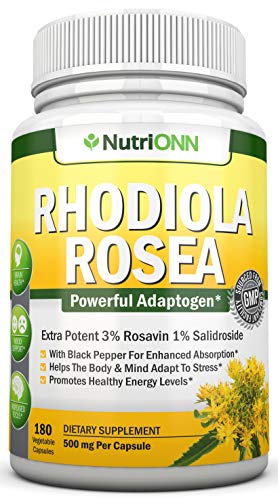
Exploring Rhodiola’s Potential for Cognitive Function
Research has investigated rhodiola’s effects on cognitive function, often in the context of stress-induced fatigue. For instance, a double-blind, cross-over study involving healthy physicians during night duty observed that a standardized rhodiola extract (SHR-5) appeared to support mental performance when experiencing stress-induced fatigue [3]. This suggests a potential role for rhodiola in situations where mental clarity might be compromised by demanding circumstances.
Another review noted that rhodiola rosea extract may have beneficial effects on mood symptoms, including anxiety and stress, which can indirectly influence cognitive clarity [4]. While not directly addressing perimenopause brain fog, these findings suggest rhodiola’s potential to support overall mental well-being, which is often intertwined with cognitive performance.
A narrative review of various nutrients and phytonutrients impacting cognitive function also included rhodiola rosea among those considered to have potential benefits for cognitive support [5]. However, it’s important to note that the strength of evidence can vary, and more targeted research specifically on perimenopause-related cognitive changes would be beneficial.

More recent research, such as a randomized, crossover, double-blind, and placebo-controlled study, is continuing to investigate the dose-response effects of rhodiola rosea supplementation on cognitive function, alongside physical performance, in specific populations like resistance-trained athletes [6]. While this particular study focuses on athletes, it underscores the ongoing scientific interest in rhodiola’s impact on mental performance and cognitive aspects.

Rhodiola and Stress: An Indirect Link to Brain Fog?
Stress is a significant factor that can exacerbate brain fog and impact cognitive function, regardless of hormonal status. Perimenopause itself can be a stressful period due to the myriad of physical and emotional changes occurring. As an adaptogen, rhodiola’s primary role is to help the body manage stress [2]. By potentially mitigating the physiological and psychological effects of stress, rhodiola might indirectly help improve cognitive clarity that is otherwise clouded by high stress levels. This indirect mechanism could be particularly relevant for women experiencing brain fog that feels linked to increased stress during midlife.
Considerations for Use
While the evidence for rhodiola’s support of cognitive function, especially in stress-related contexts, is moderate, it’s important to approach supplementation thoughtfully. The efficacy can depend on the specific extract used, the dosage, and individual responses. Most studies have used standardized extracts, often focusing on the rosavin and salidroside content [1].
It’s also worth noting that research on rhodiola often involves populations experiencing fatigue or stress, which may not directly mirror the specific hormonal changes and cognitive symptoms of perimenopause. Therefore, while promising, more targeted research on rhodiola’s direct impact on perimenopause brain fog would provide clearer insights.
References
- Rosenroot (Rhodiola rosea): traditional use, chemical composition, pharmacology and clinical efficacy. Phytomedicine : international journal of phytotherapy and phytopharmacology, 2010
- The Effectiveness of Rhodiola rosea L. Preparations in Alleviating Various Aspects of Life-Stress Symptoms and Stress-Induced Conditions-Encouraging Clinical Evidence. Molecules (Basel, Switzerland), 2022
- Rhodiola rosea in stress induced fatigue–a double blind cross-over study of a standardized extract SHR-5 with a repeated low-dose regimen on the mental performance of healthy physicians during night duty. Phytomedicine : international journal of phytotherapy and phytopharmacology, 2000
- The Effects of Rhodiola rosea L. Extract on Anxiety, Stress, Cognition and Other Mood Symptoms. Phytotherapy research : PTR, 2015
- The effects of twenty-one nutrients and phytonutrients on cognitive function: A narrative review. Journal of clinical and translational research, 2021
- Dose-Response Effects of Short-Term Rhodiola rosea (Golden Root Extract) Supplementation on Anaerobic Exercise Performance and Cognitive Function in Resistance-Trained Athletes: A Randomized, Crossover, Double-Blind, and Placebo-Controlled Study. Nutrients, 2025
These statements have not been evaluated by the Food and Drug Administration. This information is not intended to diagnose, treat, cure, or prevent any disease. Content is for informational purposes only and is not medical advice; consult a qualified healthcare provider before starting any supplement. As an Amazon Associate we earn from qualifying purchases.
